
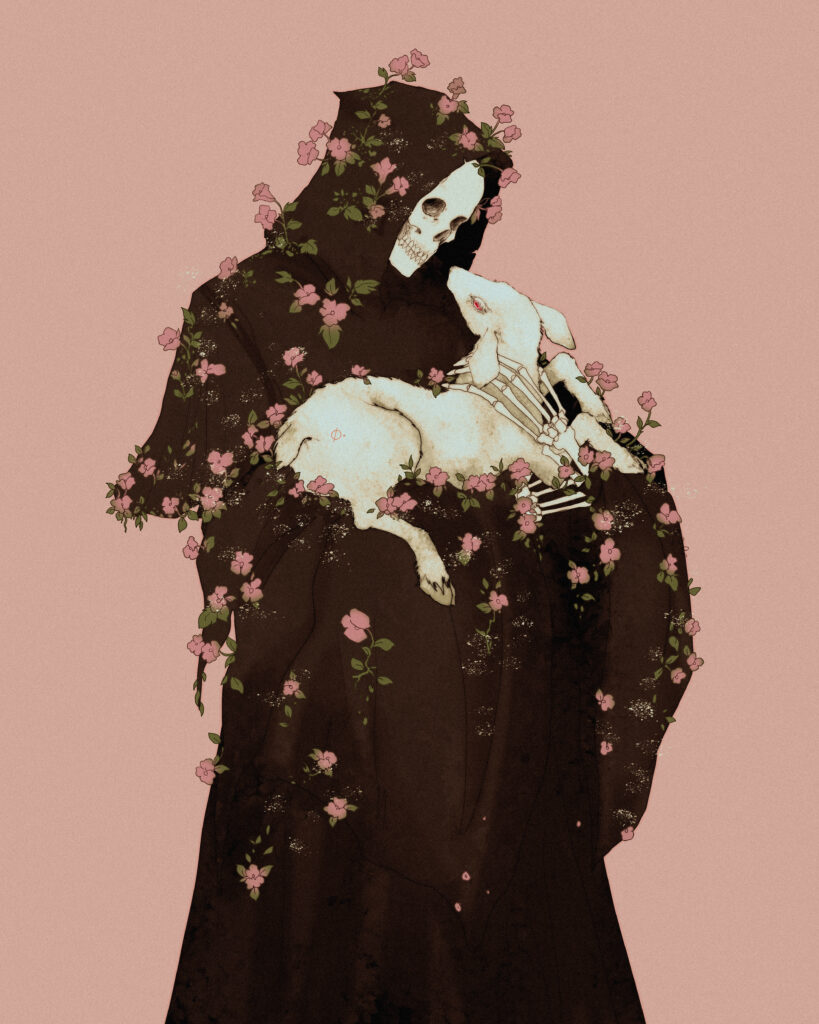
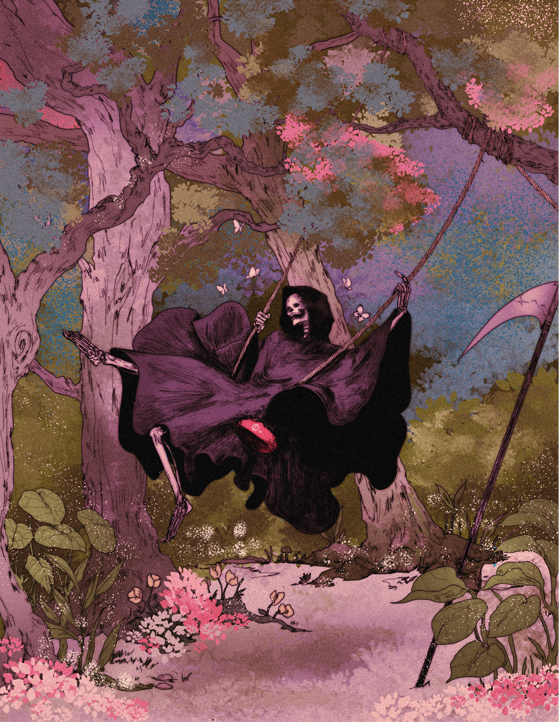
The Danse Macabre, the memento mori, the Triumph of Death. The Ars Moriendi, the Vanitas. Art history is filled with images of death and the transience of existence. These are iconographic themes that have returned since time immemorial, reminding us of our human nature and of the simple truth that everything flows and everything passes: life, suffering, every season of our existence.
It is refreshing to come across artists like UngfiΦ in the age of digital art. I believe it takes a particular sensitivity to make these themes, these icons and archetypes—so often dismissed as anachronistic, wrapped as we are in an individualistic, materialistic society deeply attached to the illusion of never growing old—the defining hallmark of one’s artistic practice.
I was drawn to my guest’s work from the very beginning. Beyond its echoes of the classical tradition, I believe her art stands out for its brilliant use of colour, impeccable technique, and its remarkable ability to build compelling environments and atmospheres through composition and subject matter.
I wanted to explore her work more deeply because, as you may already know, I have a soft spot for emerging artists. Ladies and gentlemen, without further ado, here is my interview with UngfiΦ.
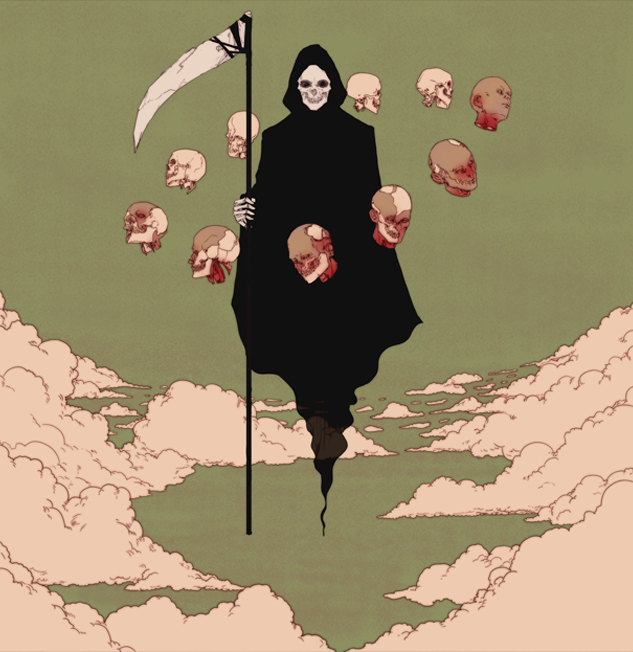
Welcome to the Magazine. Tell us about yourself and your artistic journey. How did you become the artist you are today?
After studying art and graduating from college, COVID hit, and that’s when my very solitary artistic career began. I wasn’t too worried about finding a stable job because I’d worked two jobs while I was studying and had managed to save enough money to support myself for a while.
During the pandemic, I started posting my drawings online simply for fun. Over time, more people discovered my work. They began commissioning pieces and asking where they could buy prints or merchandise, even though I hadn’t originally planned to sell anything.
After a lot of encouragement, I opened shops on INPRNT and TeePublic so people could purchase prints and apparel. I also realized how adaptable my work was, so I started accepting all kinds of commissions: book covers, tattoos, memorial portraits of beloved pets, and much more. My illustrations could easily become prints, mugs, shirts, stickers, and other products.
Eventually, I grew tired of working exclusively in digital art and began painting. I’m still discovering my voice as a painter, but people always seem excited whenever I share a new painting because it’s something I do less frequently. Around the same time, my audience kept asking me to create a card deck, which I eventually did.
Little by little, I built my own artistic career and a wonderful community around digital illustration, painting, and what I like to think is a healthy parasocial relationship with the people who follow my work.
What does art mean to you? What role does it play in your life, both creatively and personally?
I have a complicated relationship with art. It’s very much a love-hate relationship.
For most of my life, art was my escape from reality—from people, from overthinking, from everything. I’ve never been particularly social, and I wasn’t a great student either, so drawing became my way of avoiding conversations, tuning out during class, and retreating into my own world.
College made me realize that drawing had become my main coping mechanism. I drew during lectures I wasn’t interested in, I drew at work, and I simply kept improving. College gave me technical skills, but it also taught me something more difficult: when art becomes both your passion and your profession, it can start to feel very heavy.
After graduating, art slowly stopped being my refuge and became my job. That shift led to a personal crisis. I found myself creating primarily to earn a living rather than because I loved it or needed it emotionally. I’m still trying to rebuild that relationship today, and it’s an ongoing process.
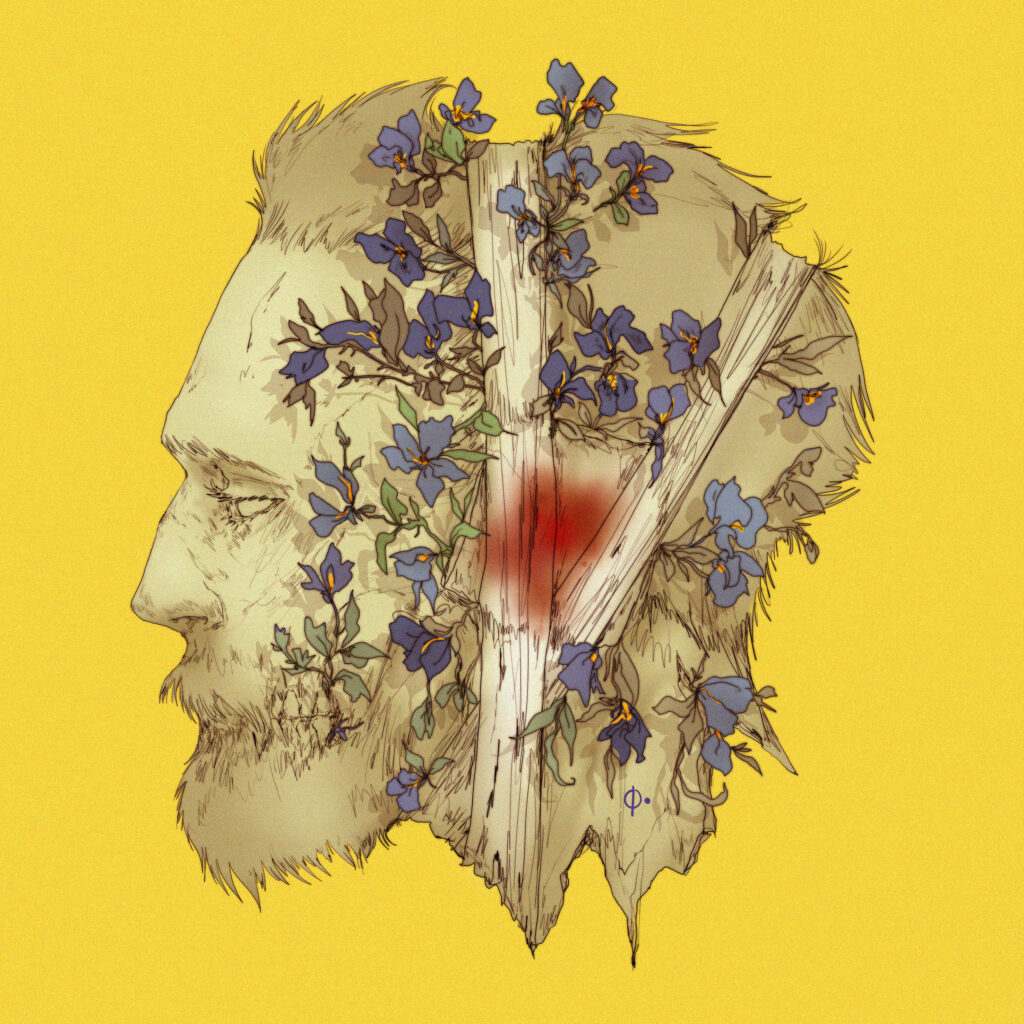
Death, the human body, and nature are recurring themes throughout your work. How did your fascination with these subjects begin, and what do they represent within your artistic universe?
It all began when my grandmother died. I was eight years old, and I witnessed her passing. It wasn’t dramatic in the way people often imagine—it was simply something I experienced. But one image never left me: my mother gently closing my grandmother’s mouth with a cloth after she passed away.
Whether that memory became a trauma or a form of acceptance, I’m still not sure. I only know that it stayed with me.
A few years later, when I was eleven, my father took me to Bodies: The Exhibition. I was completely fascinated. He even bought me the exhibition book, which I treasured for years. For a while, I genuinely wanted to become a forensic pathologist or work in a morgue. The inside of the human body felt like another universe to me—astonishingly complex and unexpectedly beautiful.
Since then, those ideas have naturally found their way into my work. To me, they represent both an acceptance of death and a celebration of the extraordinary beauty of the human body.
Your artworks seem to exist in a space between beauty and unease, reality and symbolism. How do you create this balance, and what are you hoping to explore through these images?
I always try to approach these subjects with respect. I know death isn’t easy for many people, so I want to portray it honestly while also making it feel approachable.
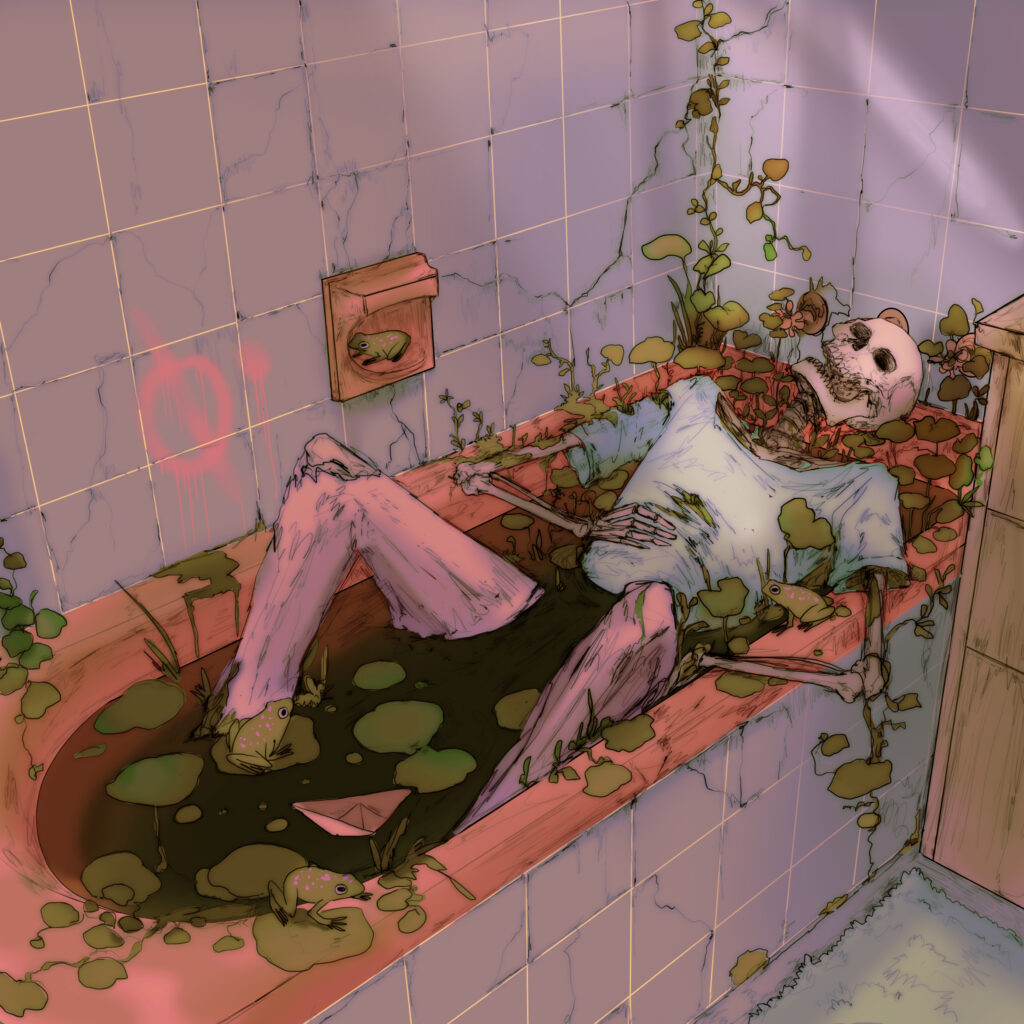
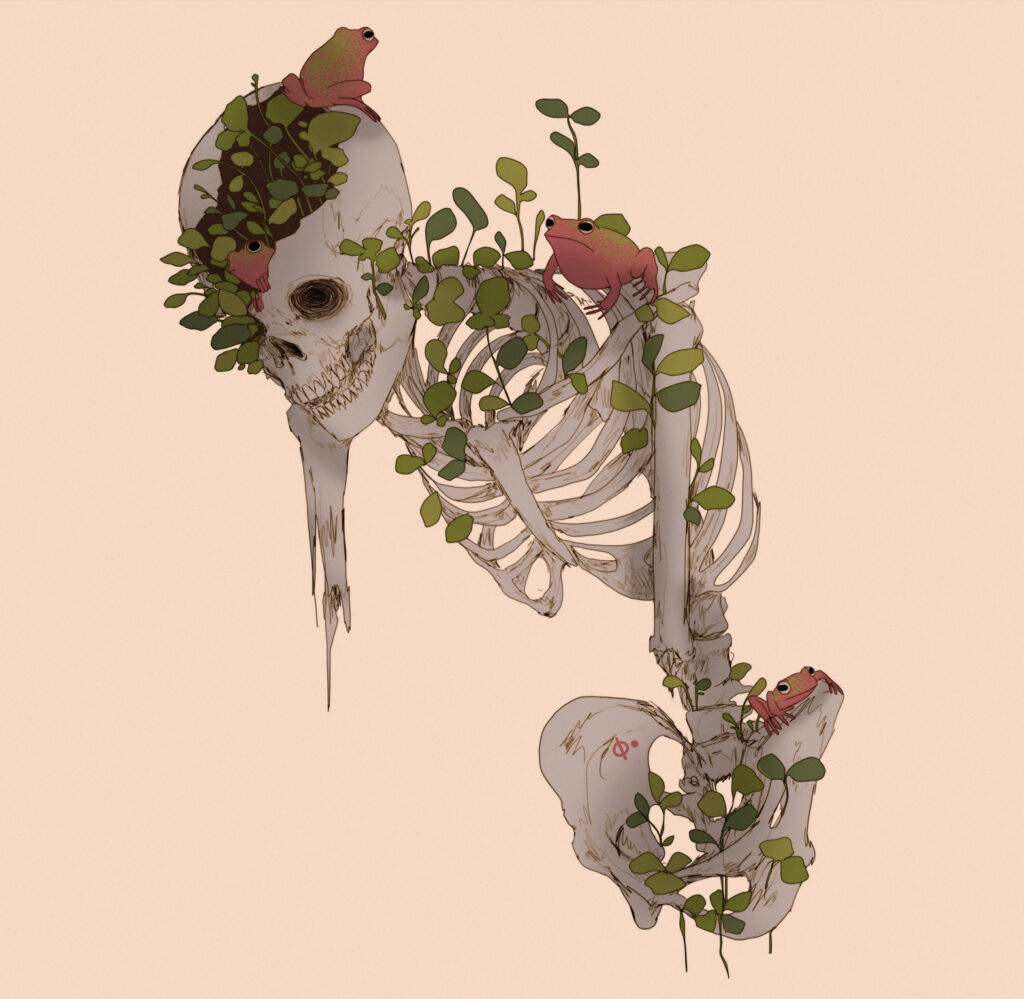
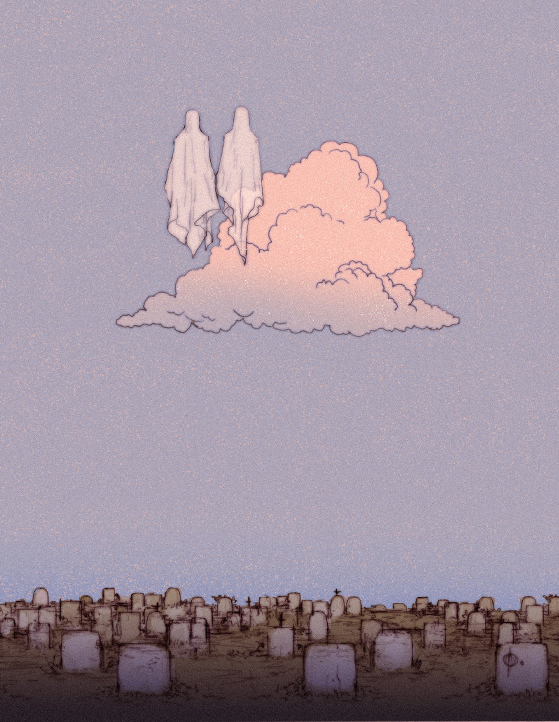
Death can be frightening or disturbing, so I often combine macabre imagery with elements that introduce an unexpected sense of beauty. That’s where nature comes in: flowers, plants, animals, clouds—symbols of life existing alongside death.
I enjoy bringing those opposites together because, to me, they aren’t really opposites at all. Life and death are part of the same experience. Through my work, I hope people can see death as a natural part of existence rather than something to fear or reject.
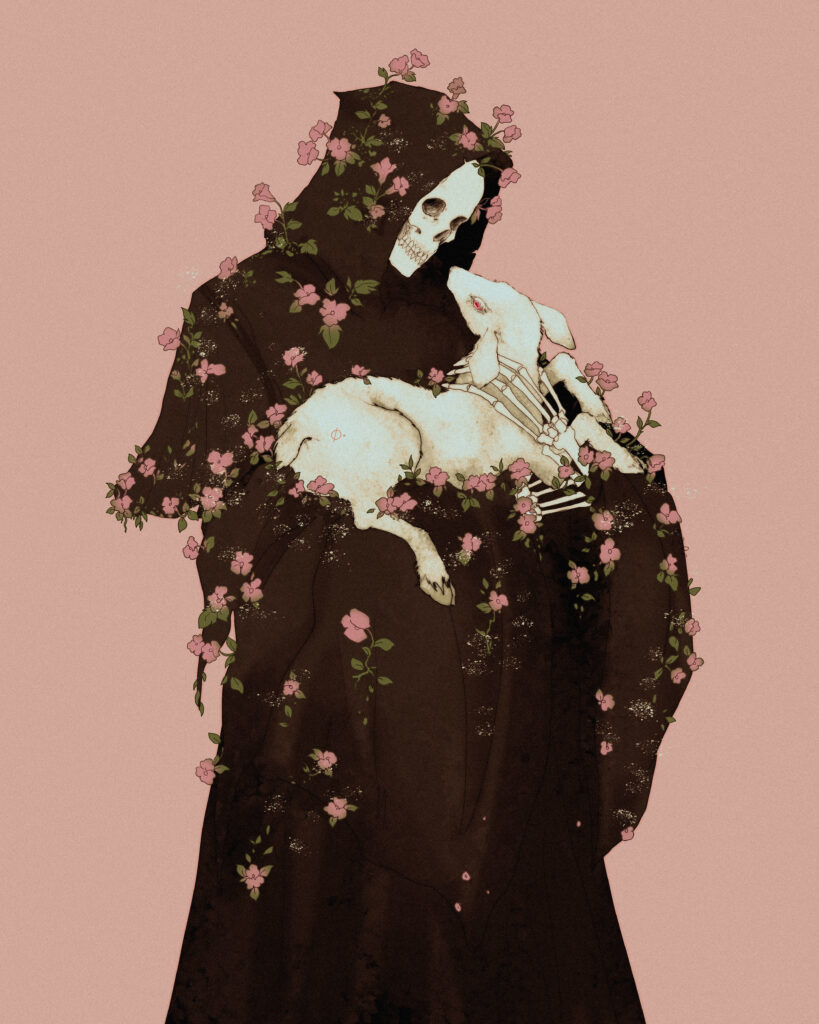
Your work carries a strong emotional and symbolic presence. What emotions do you hope to evoke or inspire in your audience?
I’ve never set out to make people feel something specific through my work. But over time, I’ve realized that many people find comfort in it, and that continues to surprise me.
One experience I’ll never forget involved a woman who commissioned a gift for her friend after her dog had passed away. She asked me to draw her friend with her dog wearing a little ghost sheet, surrounded by daisies, both of them looking lovingly at one another.
While I was creating the piece, I approached it professionally. It was simply another commission. But later, the client sent me a video of her friend’s reaction.
Watching it completely changed how I saw my work. She was heartbroken, but at the same time visibly comforted. It felt as though the drawing had helped her process her grief while preserving the joyful memory of her companion.
It’s still surreal to me that something I create can have that kind of emotional impact on another person.
You have cited Moebius and Joel-Peter Witkin as two of your greatest artistic influences. What have they taught you, and how have they shaped your artistic vision? Are there any other artists—or even figures from other creative fields—who continue to inspire your work today?
I discovered Moebius as a teenager, and his work taught me an enormous amount about perspective, environments, colour, and the use of light and shadow. His influence on me has been largely aesthetic.
Joel-Peter Witkin, on the other hand, helped me understand my fascination with the uncomfortable and the grotesque. His work made me feel understood. I sometimes joke that my own work is what you’d get if Moebius and Witkin had a child.
My favourite artist in the world, though, is Vincent van Gogh. Ironically, it’s not so much his paintings that inspire me, but his life. Learning about him keeps me grounded and reminds me how fortunate I am. Whenever I lose sight of why I make art, thinking about Van Gogh helps me reconnect with that purpose.
Another artist I deeply admire is Rebecca Dautremer. I actually collect her books because I think she creates some of the most beautiful illustrations I’ve ever seen. I love her technique, her delicacy, and the incredible atmosphere she creates. She’s a constant source of inspiration, and I hope that one day my craftsmanship will reach that level.
Looking ahead, what challenges, experiments, or projects are you most excited to pursue? What can we expect from UngfiΦ in the future?
Right now, my biggest goal is to find my escape through art again. I’m trying not to think so much about the outside world and instead return to the way I created as a child, when I could disappear into my imagination and simply draw whatever I found there.
As for future projects, I’m currently working on a tarot deck, an illustrated book, and—hopefully, one day—I’ll finally finish my short animated film.
Yes, I animate from time to time as well.
Thank you so much, UngfiΦ, and thanks to all of you for following the magazine.
See you next time!
Gianmaria Simone
La danza macabra, il memento mori, il Trionfo della Morte. L’Ars Moriendi, la Vanitas. La storia dell’arte è piena di icone della morte e della caducità. Sono temi iconografici che ritornano dall’alba dei tempi, a ricordo della nostra natura umana, a rammentarci che tutto scorre e tutto passa: la vita, il dolore, ogni stagione dell’esistenza.
È rinfrancante trovare artisti come UngfiΦ nell’era dell’arte digitale. Penso che serva una sensibilità particolare per fare di questi temi, di queste icone e di questi archetipi – spesso giudicati anacronistici, avvolti come siamo in una società individualista, materialista e tremendamente attaccata all’idea di non invecchiare – la cifra stilistica fondamentale della propria ricerca.
Ho apprezzato sin da subito l’arte della mia ospite di oggi. Credo che, al di là dei richiami classici, il suo lavoro spicchi per il brillante uso dei colori, l’impeccabile tecnica e la mai banale costruzione di ambienti e atmosfere attraverso la composizione dell’opera e la scelta del soggetto.
Ho voluto indagare un po’ più a fondo perché, si sa, amo l’arte emergente. Signore e signori, di seguito l’intervista con UngfiΦ.
Grazie di essere qui. Raccontaci di te e del tuo percorso artistico. Come sei diventata l’artista che sei oggi?
Dopo aver studiato arte e conseguito la laurea, è arrivato il COVID, ed è stato allora che è iniziata la mia carriera artistica, piuttosto solitaria. Non ero troppo preoccupata di trovare un lavoro stabile, perché durante gli studi avevo avuto due impieghi e avevo messo da parte abbastanza soldi da potermi mantenere per un po’.
Durante la pandemia ho iniziato a pubblicare i miei disegni online semplicemente per divertimento. Col tempo sempre più persone hanno scoperto il mio lavoro. Hanno iniziato a commissionarmi opere e a chiedermi dove poter acquistare stampe o merchandising, anche se all’inizio non avevo alcuna intenzione di vendere.
Dopo aver ricevuto tanti incoraggiamenti, ho aperto dei negozi su INPRNT e TeePublic, così che le persone potessero acquistare stampe e altri prodotti. Mi sono anche resa conto che il mio stile si adattava facilmente a progetti molto diversi, così ho iniziato ad accettare commissioni di ogni tipo: copertine di libri, tatuaggi, ritratti commemorativi di animali domestici e molto altro. Le mie illustrazioni potevano trasformarsi facilmente in stampe, tazze, magliette, adesivi e altri oggetti.
A un certo punto, però, mi sono stancata di lavorare esclusivamente in digitale e ho iniziato a dipingere. Sto ancora cercando la mia voce nella pittura, ma ogni volta che condivido un nuovo dipinto le persone sembrano entusiasmarsi, forse proprio perché non è qualcosa che faccio molto spesso. Più o meno nello stesso periodo, molti mi chiedevano di realizzare un mazzo di carte, e alla fine l’ho fatto.
Poco alla volta ho costruito la mia carriera artistica e una splendida comunità attorno all’illustrazione digitale, alla pittura e a quello che mi piace definire un rapporto parasociale sano con le persone che seguono il mio lavoro.
Che cosa rappresenta l’arte per te? Quale ruolo ha nella tua vita, sia dal punto di vista creativo che personale?
Ho un rapporto complicato con l’arte. È decisamente una relazione di amore e odio.
Per gran parte della mia vita l’arte è stata la mia via di fuga dalla realtà: dalle persone, dai miei pensieri, praticamente da tutto. Non sono mai stata una persona particolarmente socievole e nemmeno una studentessa brillante, quindi disegnare è diventato il mio modo di evitare le conversazioni, di estraniarmi durante le lezioni e di rifugiarmi nel mio mondo.
L’università mi ha fatto capire che il disegno era diventato il mio principale meccanismo di difesa. Disegnavo durante le lezioni che non mi interessavano, disegnavo al lavoro e continuavo semplicemente a migliorare. Gli studi mi hanno dato una solida preparazione tecnica, ma mi hanno anche insegnato qualcosa di più difficile: quando l’arte diventa allo stesso tempo la tua passione e il tuo mestiere, può trasformarsi in un peso.
Dopo la laurea, l’arte ha smesso lentamente di essere il mio rifugio per diventare il mio lavoro. Quel cambiamento ha dato origine a una crisi personale. Mi sono ritrovata a creare soprattutto per guadagnarmi da vivere, piuttosto che perché ne sentissi il bisogno o il piacere. Ancora oggi sto cercando di ricostruire quel rapporto, ed è un percorso tuttora in corso.
La morte, il corpo umano e la natura sono temi ricorrenti nelle tue opere. Come è nata questa fascinazione e che cosa rappresentano all’interno del tuo universo artistico?
Tutto è iniziato quando è morta mia nonna. Avevo otto anni e ho assistito alla sua morte. Non è stato drammatico nel senso in cui le persone lo immaginano di solito: è stato semplicemente qualcosa che ho vissuto. Ma c’è un’immagine che non mi ha mai abbandonata: mia madre che, con estrema delicatezza, le chiudeva la bocca con un panno dopo la sua morte.
Non so se quel ricordo sia diventato un trauma o una forma di accettazione. So solo che è rimasto con me.
Qualche anno dopo, quando avevo undici anni, mio padre mi portò a visitare Bodies: The Exhibition. Ne rimasi completamente affascinata. Mi comprò perfino il catalogo della mostra, che ho custodito per anni. Per un periodo ho desiderato davvero diventare un medico legale o lavorare in un obitorio. L’interno del corpo umano mi sembrava un universo a sé, incredibilmente complesso e, allo stesso tempo, sorprendentemente bello.
Da allora questi temi sono entrati naturalmente nel mio lavoro. Per me rappresentano sia l’accettazione della morte sia la straordinaria bellezza del corpo umano.
Le tue opere sembrano esistere in uno spazio sospeso tra bellezza e inquietudine, realtà e simbolismo. Come costruisci questo equilibrio e che cosa cerchi di esplorare attraverso queste immagini?
Cerco sempre di affrontare questi argomenti con rispetto. So che la morte è un tema difficile per molte persone, quindi voglio rappresentarla con sincerità, ma anche renderla in qualche modo accessibile.
La morte può fare paura o risultare disturbante, perciò spesso accosto immagini macabre a elementi che introducono un senso di bellezza inaspettata. È qui che entra in gioco la natura: fiori, piante, animali, nuvole, simboli di vita che convivono con la morte.
Mi piace far dialogare questi due aspetti perché, ai miei occhi, non sono davvero opposti. Vita e morte fanno parte della stessa esperienza. Attraverso il mio lavoro spero che le persone possano vedere la morte come una parte naturale dell’esistenza, piuttosto che come qualcosa da temere o rifiutare.
Le tue opere hanno una forte carica emotiva e simbolica. Quali emozioni speri di suscitare nel pubblico? C’è una reazione dei tuoi spettatori che ti ha colpita più di altre?
Non ho mai creato con l’intenzione di suscitare un’emozione precisa. Col tempo, però, mi sono resa conto che molte persone trovano conforto nelle mie opere, ed è una cosa che continua a sorprendermi.
Un episodio che non dimenticherò mai riguarda una donna che mi commissionò un regalo per un’amica il cui cane era morto da pochi giorni. Mi chiese di ritrarre l’amica insieme al suo cane, avvolto da un piccolo lenzuolo da fantasma, circondati da margherite mentre si guardavano con affetto.
Mentre lavoravo al disegno lo affrontavo semplicemente come una commissione, senza particolare coinvolgimento emotivo. Ma in seguito la cliente mi inviò un video della reazione della sua amica.
Vederlo cambiò completamente il mio modo di guardare al mio lavoro. Era distrutta dal dolore, ma allo stesso tempo sembrava trovare conforto. Mi è sembrato che quel disegno l’avesse aiutata a elaborare il lutto, conservando al tempo stesso il ricordo felice del suo compagno di vita.
Ancora oggi mi sembra surreale pensare che qualcosa che creo possa avere un impatto emotivo così profondo sulle persone.
Hai citato Moebius e Joel-Peter Witkin come due delle tue maggiori influenze artistiche, nonostante i loro linguaggi siano molto diversi. Che cosa ti hanno insegnato e in che modo hanno plasmato la tua visione artistica? Ci sono altri artisti, o magari figure provenienti da altri ambiti creativi, che continuano a ispirarti?
Ho scoperto Moebius da adolescente e il suo lavoro mi ha insegnato moltissimo sulla prospettiva, sugli ambienti, sul colore e sull’uso della luce e delle ombre. Direi che la sua influenza su di me è stata soprattutto estetica.
Joel-Peter Witkin, invece, mi ha aiutata a comprendere la mia fascinazione per ciò che è scomodo e grottesco. Le sue opere mi hanno fatto sentire compresa. Ogni tanto scherzo dicendo che il mio lavoro è ciò che nascerebbe se Moebius e Witkin avessero un figlio.
Il mio artista preferito in assoluto, però, è Vincent van Gogh. Paradossalmente, non sono tanto i suoi dipinti a ispirarmi quanto la sua vita. Conoscere la sua storia mi aiuta a rimanere con i piedi per terra e mi ricorda quanto io sia fortunata. Ogni volta che perdo di vista il motivo per cui faccio arte, ripensare a Van Gogh mi aiuta a ritrovarlo.
Un’altra artista che ammiro profondamente è Rebecca Dautremer. Colleziono persino i suoi libri, perché penso realizzi alcune delle illustrazioni più belle che abbia mai visto. Amo la sua tecnica, la sua delicatezza e le atmosfere straordinarie che riesce a creare. È una fonte costante di ispirazione e spero un giorno di raggiungere un livello di maestria simile.
Guardando al futuro, quali sfide, sperimentazioni o progetti ti entusiasmano di più? Che cosa possiamo aspettarci da UngfiΦ?
In questo momento il mio obiettivo principale è ritrovare nell’arte quella via di fuga che rappresentava per me un tempo. Sto cercando di pensare meno al mondo esterno e di tornare a creare come facevo da bambina, quando potevo perdermi nella mia immaginazione e disegnare semplicemente ciò che vi trovavo.
Per quanto riguarda i progetti futuri, sto lavorando a un mazzo di tarocchi, a un libro illustrato e, spero un giorno, riuscirò finalmente a terminare il mio cortometraggio animato.
Sì, ogni tanto mi dedico anche all’animazione.
Grazie di essere stata qui. Grazie a voi per seguire sempre il magazine e di supportarlo con like, commenti e iscrizione alla newsletter.
Alla prossima!
Gianmaria Simone.
I contatti dell’ospite
I nostri contatti social
What I seriously think most in regard to is health themes.
By myself, I subscribe to newspapers that concerns this subject, and I continue informed about the latest health
lab analyses. Just how is this of any use? I feel there’s no more critical use for my
hours. Furthermore, this blog seems as though it’s worthy of the
time to check out again. I dig through 1000s or even more of sites every week.
Honestly, my rear usually is painful and I desire a different hobby.
lol Nevertheless, I think if everybody wrote about their niche in the universe, and did so
articulately, we’d have a much more interesting world.
I appreciate your providing these details for individuals aiming
to get more information on subject areas like this.
Your weblog was well-written and very well researched,
and that is quite definitely treasured. I actually am constantly looking
for new sites to follow and read regularly.
Thanks!