
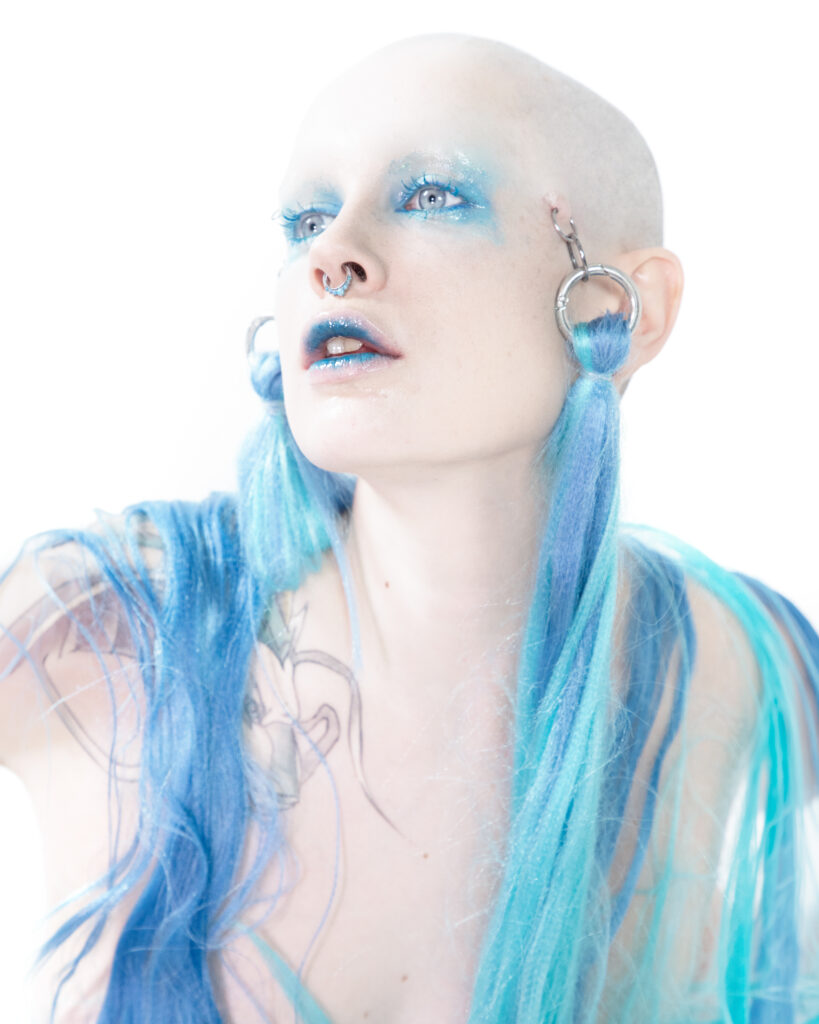
Trovo di immediata efficacia, oltre che di genuina franchezza, gli artisti che utilizzano il corpo come tela della propria arte. Perché, in fondo, cos’è l’arte? È l’espressione raffinata di ciò che abbiamo dentro: della nostra storia, delle esperienze che ci attraversano, delle cose che ci stanno a cuore, dei messaggi che desideriamo comunicare e della nostra identità.
Sono Gianmaria Simone e con Minimal Magazine raccolgo, analizzo e condivido ciò che reputo d’interesse. Prima di tutto per me stesso: un modo per confrontarmi con chi sceglie linguaggi diversi e racconta, attraverso strumenti differenti, ciò che io cerco di esplorare con carta e penna.
Maite è un’artista che desideravo intervistare da tempo. Rimasto colpito dall’impeccabile ricerca estetica che emerge dal suo profilo social (link a piè di pagina), ho voluto andare oltre l’apparenza e comprendere cosa si celasse dietro le fotografie. Dalla lunghezza dell’articolo di oggi si può facilmente intuire che la risposta è: molto, moltissimo.
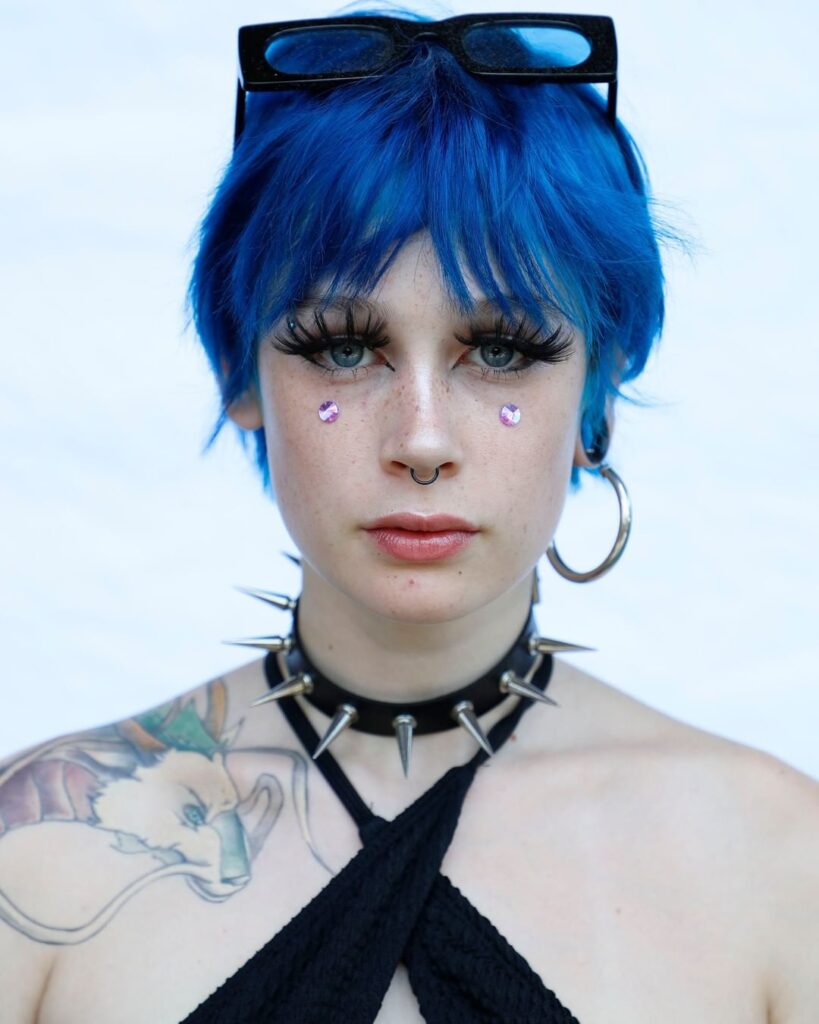
Il corpo, si diceva. Il corpo può diventare un veicolo di stati d’animo, messaggi profondi, dichiarazioni universali e un generatore inesauribile di emozioni differenti. Quando attraverso di esso vengono costruite performance, quando viene accompagnato da un’estetica precisa, da abiti, oggetti e simboli scelti con cura, può essere sottratto alla dimensione individuale per aprire una riflessione più ampia, capace di andare oltre il singolo performer.
È un modello espressivo di cui sono profondamente invidioso. Ma cosa serve, oltre a una buona dose di coraggio, per intraprendere questa strada nel mondo dell’arte? Ho portato qui Maite proprio per provare a rispondere a questa domanda.
In lei ho trovato un’artista strutturata, consapevole del proprio percorso e della direzione verso cui sta conducendo la propria ricerca creativa. Un’artista matura, che sono lieto di ospitare oggi sulle pagine del Magazine.
Ciao Maite e grazie di essere qui a raccontarti per Minimal Magazine. Se guardi indietro al tuo percorso, dal Liceo Artistico di Cuneo fino a oggi a Milano, come descriveresti la tua evoluzione e cosa cercavi in questo cambiamento di contesto?
Ciao, grazie a te per l’opportunità!
Se guardo indietro al mio percorso, mi accorgo che non è stato una successione di cambiamenti, ma un progressivo avvicinarmi a ciò che sono. Ogni fase mi ha insegnato un linguaggio diverso: prima l’immagine, poi il corpo e infine la performance. Oggi questi elementi convivono naturalmente nella mia pratica artistica.
Al Liceo Artistico non avevo ancora le idee chiare sul mio futuro. Ho scelto l’indirizzo di Grafica perché era il linguaggio che in quel momento sentivo più vicino, ma quasi nello stesso periodo è accaduto qualcosa che avrebbe cambiato il mio percorso.
Alcune amiche, studentesse di fotografia, hanno iniziato a coinvolgermi come soggetto dei loro shooting. Avevo appena sedici anni e, senza rendermene conto, stavo già iniziando a interrogarmi sul rapporto tra il mio corpo e l’immagine.
Con il tempo non mi è più bastato essere davanti all’obiettivo. Ho iniziato a ideare io stessa i concept delle fotografie, collaborando con fotografi e fotografe per costruire immagini che rispecchiassero il mio immaginario. È stato lì che ho capito di voler essere non solo il soggetto di un’opera, ma anche la persona che la pensa e la dirige.
Da quel momento ho iniziato a viaggiare sempre di più: prima Torino, poi Roma e infine Milano. Ogni città mi ha permesso di incontrare artisti, performer e creativi che hanno ampliato il mio sguardo e alimentato la mia ricerca.
Provengo dalla provincia di Cuneo e, crescendo, ho spesso percepito quel contesto come troppo stretto rispetto al tipo di persona che stavo diventando. Sentivo il bisogno di confrontarmi con realtà più aperte, dove la sperimentazione fosse considerata una possibilità e non qualcosa da guardare con sospetto.
Dopo la maturità ho cercato un’Accademia che potessi permettermi grazie a una borsa di studio e mi sono trasferita a Milano. È stata una scelta liberatoria, ma anche molto impegnativa. Ho dovuto imparare a costruire da sola la mia quotidianità, affrontando responsabilità, relazioni e un ambiente estremamente competitivo. Non è stato sempre semplice, ma ogni esperienza mi ha aiutata a definire con maggiore chiarezza la mia identità.
Oggi sento di aver trovato una comunità di persone che crede nella mia ricerca e sostiene anche le idee più audaci. Guardando indietro, mi accorgo che ogni passaggio mi ha portata sempre più vicina alla persona e all’artista che sono oggi.
Nelle tue performance usi spesso elementi del mondo circense, dal makeup alla pratica di “mangiafuoco”. Come sono entrati questi linguaggi nella tua arte e cosa ti permettono di esprimere?
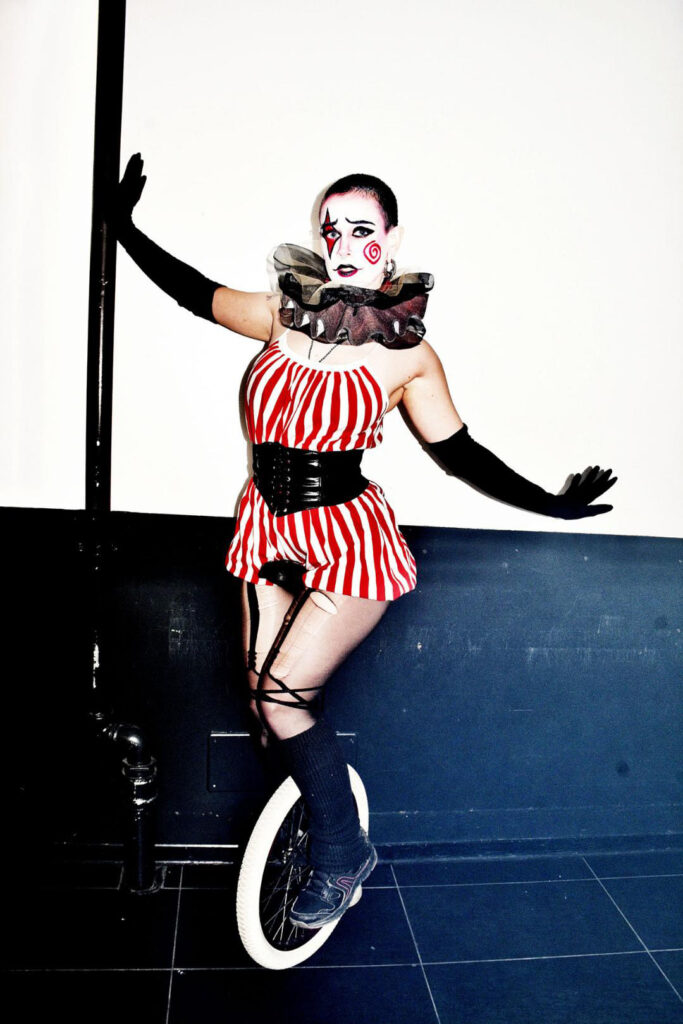
Il linguaggio circense fa parte della mia storia ancora prima della mia nascita. I miei genitori erano artisti di strada e per anni hanno viaggiato, soprattutto in Spagna, realizzando spettacoli con il fuoco. Sono cresciuta osservando quel mondo da vicino e, fin da bambina, i miei genitori mi hanno iscritta a una scuola di circo. È lì che ho imparato ad andare in monociclo, un’esperienza che mi ha insegnato fin da piccola il valore dell’equilibrio, della coordinazione e della fiducia nel corpo.
Il fuoco è arrivato un po’ più tardi. Da bambina mia madre ogni tanto mi lasciava tenere in mano le bolas e, durante gli anni del liceo, mi capitava di usarle per animare qualche festa tra amici. Era però ancora un gioco, un’eredità familiare che non avevo deciso di fare davvero mia.
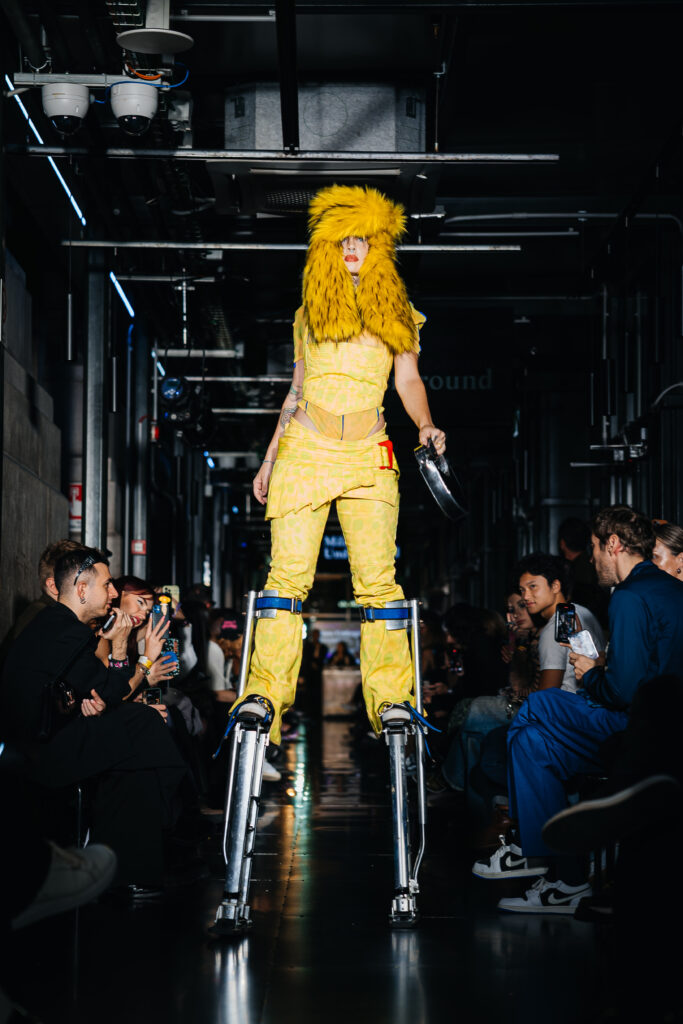
Il vero cambiamento è arrivato nel 2022, con il mio trasferimento a Milano. Grazie ad alcuni amici, che ancora oggi sono i miei compagni di allenamento, ho iniziato a praticare il fuoco con costanza, studiando il movimento e la tecnica in maniera molto più consapevole. Da conoscere soltanto le bolas sono passata a utilizzare ventagli, bacchette e coppe di fuoco, costruendo spettacoli sempre più complessi. Negli ultimi anni ho anche ripreso a lavorare sui trampoli, riportando nella mia pratica un altro elemento del linguaggio circense che avevo lasciato da parte.
Queste discipline mi hanno aperto le porte del mondo dell’intrattenimento, permettendomi di esibirmi in locali, eventi e festival. Ma soprattutto mi hanno insegnato qualcosa sul corpo. Che si tratti di un monociclo, dei trampoli o del fuoco, ogni pratica richiede una presenza assoluta: ogni gesto deve essere preciso, ogni esitazione può avere delle conseguenze. Sono esperienze che ti obbligano ad ascoltarti, a fidarti del tuo corpo e ad accettare il rischio senza esserne sopraffatta.
Credo che sia proprio questo il punto in cui il linguaggio circense incontra la mia ricerca artistica. Il circo, per me, non è soltanto uno strumento spettacolare o un’estetica da citare. È una scuola del corpo. Mi ha insegnato a convivere con il limite, con la paura, con l’equilibrio e con la trasformazione. Sono temi che oggi attraversano tutte le mie performance, anche quando il circo non è esplicitamente presente sulla scena.
Ti muovi costantemente tra la performance corporea e il fashion design. Che tipo di dialogo c’è per te tra il corpo nudo e l’abito che disegni?
Il rapporto tra il corpo e l’abito è il centro della mia ricerca. Ho studiato Fashion Design, ma il mio interesse per l’abbigliamento è nato molto prima dell’università. Crescendo in un piccolo paese, il modo in cui mi vestivo è stato uno dei primi strumenti attraverso cui ho affermato la mia identità. Sentivo il bisogno di esprimermi liberamente, anche quando questo significava apparire diversa o essere giudicata.
Ho capito molto presto che un abito non è mai soltanto un oggetto: è un linguaggio.
L’abito è un’estensione del corpo, quasi una seconda pelle. Mi interessa progettare capi che ne seguano i movimenti, le fragilità e le trasformazioni. Per questo, nelle mie opere, moda e performance non sono due discipline separate, ma parti dello stesso processo creativo.
Ho scelto la performance perché è il linguaggio che più di ogni altro mi permette di mettere davvero il corpo al centro. Non mi interessa rappresentare un’esperienza: mi interessa viverla insieme al pubblico. È nell’irripetibilità dell’azione che trovo il senso del mio lavoro.
L’abito diventa così anche uno strumento politico. In una società che tende sempre più all’omologazione, credo che il modo in cui scegliamo di abitare il nostro corpo e di mostrarlo possa essere un’affermazione di identità. Per me vestirsi non significa nascondersi, ma dichiarare la propria presenza.
In lavori come “Feeling Fully” o “How It Hurts” metti in gioco il dolore fisico. Qual è il tuo rapporto con questa dimensione durante l’azione performativa?
Il dolore fisico è entrato nella mia ricerca in modo sempre più consapevole da quando mi sono trasferita a Milano. Mi interrogo soprattutto sul suo rapporto con la sofferenza: mi chiedo se attraversare volontariamente un dolore fisico possa diventare un modo per comprendere, elaborare o dare forma a un dolore interiore che spesso non riusciamo nemmeno a nominare. Un dolore che, in forme diverse, appartiene a tutti e che ci accomuna come esseri umani.
Mi interessa capire cosa accade quando il corpo vive un’esperienza intensa e come questa possa creare uno spazio di riflessione, sia per me sia per chi osserva. Da un punto di vista antropologico, il dolore ha accompagnato per secoli rituali di passaggio, trasformazione e appartenenza; l’arte, allo stesso modo, ci permette di dare forma a emozioni che altrimenti rimarrebbero invisibili. Quando queste due dimensioni si incontrano, il corpo diventa un luogo di relazione, capace di generare empatia e catarsi.
Per molto tempo ho parlato di “guarigione” per descrivere questo processo. Poi, grazie al confronto con un’artista a me molto cara, ho iniziato a mettere in discussione questa parola. Mi sono resa conto che viviamo in una società che pretende continuamente di guarire, migliorare, ottimizzare e superare, come se ogni fragilità dovesse essere eliminata il più in fretta possibile.
Oggi sento che l’arte non debba guarire le persone, né che il dolore abbia sempre bisogno di una soluzione. Credo piuttosto che possa aiutarci a conoscerci meglio, a riconoscere ciò che proviamo e a scegliere come convivere con le nostre fragilità.
Per me la performance è questo: uno spazio in cui il corpo smette di inseguire l’idea di perfezione e di efficienza che la nostra società ci impone. Attraverso il dolore il corpo rallenta, si espone, si mostra vulnerabile e, proprio per questo, diventa quasi disfunzionale rispetto a un sistema che ci vuole sempre produttivi, performanti e invulnerabili. È in quella vulnerabilità che trovo la possibilità di una presa di posizione: non la ricerca di un corpo migliore, ma di un corpo più libero, più consapevole e più autentico.
Spazi pubblici, musei, club notturni: porti le tue performance in luoghi radicalmente diversi. In che modo lo spazio e il tipo di pubblico influenzano quello che fai?
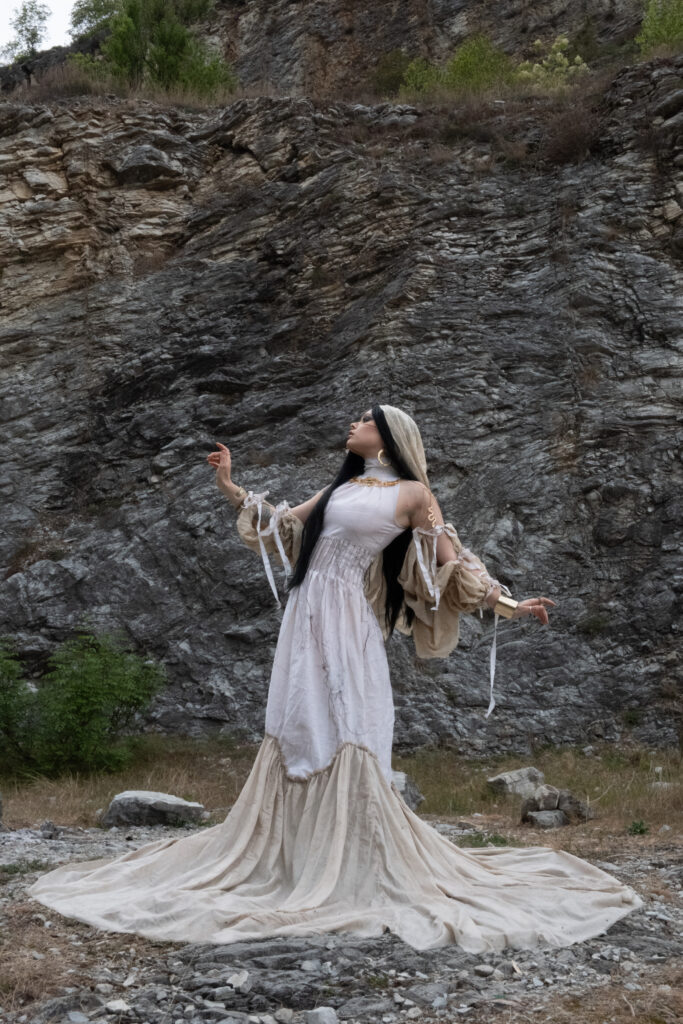
Mi piace pensare che le mie performance non appartengano a un solo tipo di spazio. Non voglio che esistano soltanto all’interno di musei o istituzioni, anche perché credo che i luoghi dell’arte non siano sempre accessibili a tutti. Mi interessa che ciò che realizzo possa vivere in contesti diversi, perché ogni luogo modifica il modo in cui il pubblico entra in relazione con l’opera.
La mia formazione personale è profondamente legata agli spazi sociali, ai centri sociali, agli squat, ai club e ai contesti alternativi. Sono ambienti che ho frequentato per anni e nei quali ho sempre trovato una grande libertà di sperimentazione. È lì che ho imparato che una performance può essere anche estrema, disturbante o visivamente molto impattante senza dover essere normalizzata per risultare accettabile. Questi luoghi continuano a rappresentare una parte fondamentale della mia identità artistica e politica.
Mi incuriosisce osservare come una stessa performance cambi completamente a seconda dello spazio in cui viene presentata. Mi capita spesso di sviluppare un lavoro in studio e poi portarlo su un palco, in un club o durante un evento. Ogni volta il contesto restituisce reazioni diverse e mi costringe a ripensare il lavoro: a volte per ragioni tecniche o logistiche, altre perché è il pubblico stesso a trasformare il significato dell’azione. È un processo di continua sperimentazione, da cui imparo sempre qualcosa.
Nell’ultimo anno, però, ho sentito il desiderio di avvicinarmi maggiormente alle istituzioni artistiche. Visitare la Biennale di Venezia e confrontarmi con artisti e studenti provenienti da percorsi legati all’arte contemporanea e alla performance art mi ha fatto capire quanto sia importante approfondire la mia ricerca anche in quella direzione, senza rinunciare alle radici da cui provengo.
Quello che immagino per il futuro non è un passaggio da un mondo all’altro, ma un ponte tra questi due contesti. Vorrei continuare a lavorare in spazi sociali e politicamente consapevoli, che sento profondamente miei, portando però la stessa energia, la stessa libertà di sperimentazione e la stessa urgenza espressiva anche all’interno delle istituzioni. Per me la coerenza non dipende dal luogo in cui espongo, ma dal modo in cui scelgo di abitare quello spazio e dalla disponibilità del pubblico a lasciarsi coinvolgere davvero.
In “uMANItà” il pubblico interviene direttamente sul tuo corpo con la vernice. Cosa succede dentro di te quando affidi totalmente agli altri l’esito del tuo lavoro?
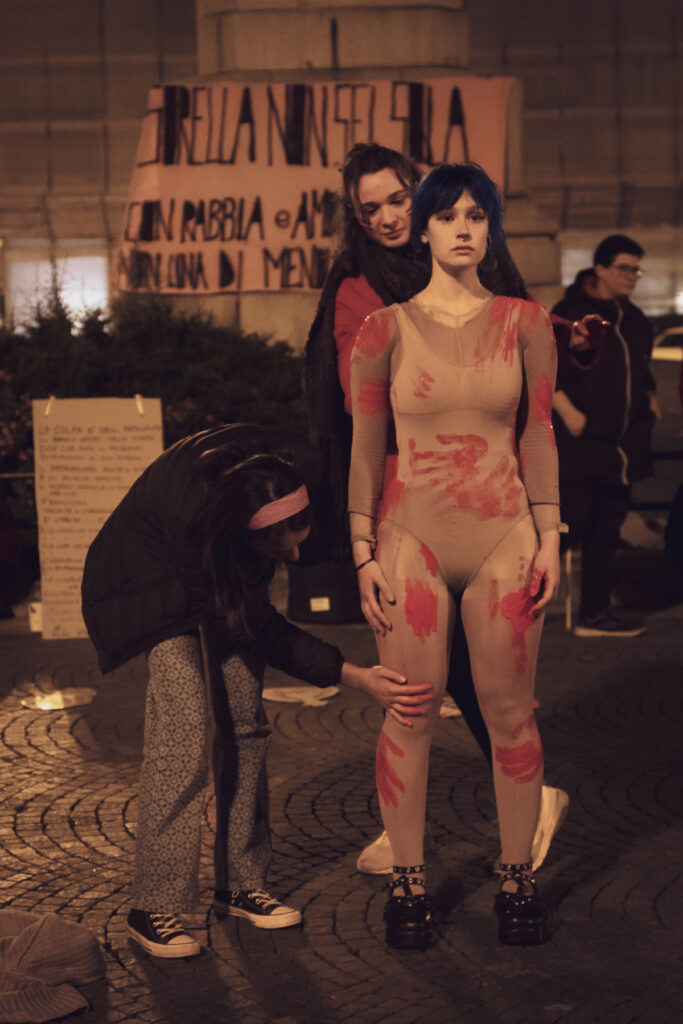
uMANItà è stata la prima performance che ho realizzato. Avevo diciotto anni e in quel periodo stavo approfondendo la ricerca di Marina Abramović e Regina José Galindo, due artiste che mi hanno fatto comprendere quanto il corpo potesse diventare un linguaggio politico oltre che artistico.
La performance è nata in occasione del 25 novembre, la Giornata internazionale per l’eliminazione della violenza contro le donne. Sentivo il bisogno di creare un’immagine che arrivasse al pubblico senza mediazioni: come uno schiaffo o, al contrario, come una carezza.
Indossavo una tutina color carne e sono rimasta immobile per circa mezz’ora al centro di Piazza Galimberti, a Cuneo, mentre le persone erano invitate a lasciare sul mio corpo un’impronta di vernice rosa. Faceva molto freddo e ogni mano bagnata che mi sfiorava rendeva quella sensazione ancora più intensa. Ma durante quei trenta minuti il freddo è passato completamente in secondo piano.
Nella mia mente continuavano a risuonare i nomi delle donne uccise in Italia in quell’anno. Era a loro che pensavo mentre osservavo il pubblico avvicinarsi. Alcuni sceglievano di sfiorarmi il volto con estrema delicatezza, altri appoggiavano la mano sul collo. Erano gesti semplici, ma profondamente diversi tra loro.
In quei momenti cercavo di ascoltare non soltanto quello che stavo provando io, ma anche ciò che percepivo negli altri. Ogni contatto sembrava portare con sé una storia, un ricordo, una paura o un bisogno di vicinanza.
Affidare il mio corpo al pubblico significava accettare di non poter controllare completamente l’esito della performance. È stato un atto di vulnerabilità, ma anche di fiducia. Credo che proprio in quello scambio risiedesse il senso di uMANItà: trasformare un gesto apparentemente semplice in un momento di responsabilità condivisa, in cui il corpo diventava uno spazio di ascolto e di empatia.
Nel campo del fashion design utilizzi molto l’upcycling e la personalizzazione dei tessuti. Cosa ti affascina del lavorare su materiali che hanno già una storia?
Quando progetto un abito è molto raro che acquisti materiali nuovi. È una scelta che nasce prima di tutto da una riflessione etica: faccio fatica a giustificare l’acquisto continuo di nuovi tessuti in un momento storico in cui produciamo e consumiamo una quantità enorme di capi destinati a durare pochissimo. Il fast fashion ci ha abituati a considerare gli oggetti come qualcosa di facilmente sostituibile, mentre io cerco di fare esattamente il contrario.
Negli anni ho conservato quasi tutto ciò che in casa stava per essere scartato: vecchi vestiti, ritagli di tessuto, accessori, materiali di recupero. Oggi il mio studio è pieno di queste cose e rappresenta una sorta di archivio personale da cui attingere ogni volta che inizio un nuovo progetto.
Inoltre, come dici tu, mi affascina anche che questi materiali abbiano già vissuto. Portano con sé segni, imperfezioni e una storia che non posso conoscere fino in fondo, ma che continua a essere presente. Quando li trasformo non cerco di cancellare quel passato, ma di farlo dialogare con qualcosa di nuovo. Mi piace pensare che anche gli oggetti possano avere una seconda possibilità.
L’upcycling, per me, non è soltanto una tecnica di progettazione, ma un modo di osservare il mondo. Mi capita spesso di camminare per strada e fermarmi davanti a qualcosa che per chiunque altro sarebbe un rifiuto. Basta un frammento di plastica, un pezzo di una moto, una rete metallica o un materiale insolito perché la mia mente inizi immediatamente a immaginare come potrebbe trasformarsi in un abito o in un elemento performativo.
Forse è anche per questo che la mia casa è piena di oggetti improbabili. Faccio fatica a separarmene, perché ognuno di loro potrebbe diventare il punto di partenza di un progetto futuro. È proprio questa continua possibilità di trasformazione che continua a emozionarmi: vedere qualcosa destinato a essere dimenticato rinascere come un pezzo unico, irripetibile, con una nuova identità.
Oltre alle performance dal vivo, al modeling e al fashion design, utilizzi anche la piattaforma OnlyFans. Un approccio diverso, feticistico, che ha nel suo nocciolo lo stesso utilizzo performativo del tuo corpo che alimenta le tue performance. Oltre chiaramente all’aspetto economico, questa ricerca, chiamiamola erotica, ha contribuito in qualche maniera alla tua arte? Ti ha fornito maggiore consapevolezza su di te o ti ha ispirato per altri progetti?
Non è mia abitudine parlare del mio lavoro come sex worker insieme alla mia ricerca artistica. Non perché tra le due cose non esista un dialogo, anzi, ma perché so che, soprattutto in Italia, questo tema è ancora fortemente stigmatizzato. Qualche mese fa, durante un talk organizzato dalla redazione di Scomodo a Milano, ho raccontato proprio questa difficoltà: il timore che una parte del mio lavoro finisca per oscurare tutto il resto, che il mio percorso venga letto attraverso un’unica lente invece che nella sua complessità.
Esiste ancora l’idea che una persona non possa essere contemporaneamente un’artista, una performer, una modella e una sex worker. Come se una definizione annullasse automaticamente tutte le altre. È questo il meccanismo che trovo più limitante, perché impedisce di guardare davvero la ricerca che c’è dietro il mio lavoro e la persona nella sua totalità.
Allo stesso tempo, però, sarebbe disonesto negare quanto questa esperienza abbia influenzato il mio rapporto con il corpo. Lavorare con la nudità e con l’esposizione di me stessa mi ha costretta a confrontarmi ogni giorno con lo sguardo degli altri e con il mio. Mi ha dato una consapevolezza del corpo che probabilmente non avrei sviluppato nello stesso modo, insegnandomi ad abitarlo con maggiore libertà e intenzionalità.
Questa esperienza mi ha portata anche ad avvicinarmi alla dimensione politica della lotta per i diritti delle sex worker. Il confronto con altre persone che vivono questa realtà mi ha fatto comprendere quanto lo stigma sociale possa diventare una forma di esclusione e di controllo, e quanto sia importante rivendicare la possibilità di autodeterminarsi sul proprio corpo e sul proprio lavoro.
Questa riflessione è entrata naturalmente anche nella mia ricerca artistica. La performance che ho presentato dopo quel talk affrontava proprio questi temi attraverso l’immagine di catene e legami che segnano il corpo: simboli del pregiudizio, delle etichette e delle forme di controllo, anche invisibili, che spesso limitano la libertà di essere riconosciuti nella propria complessità.
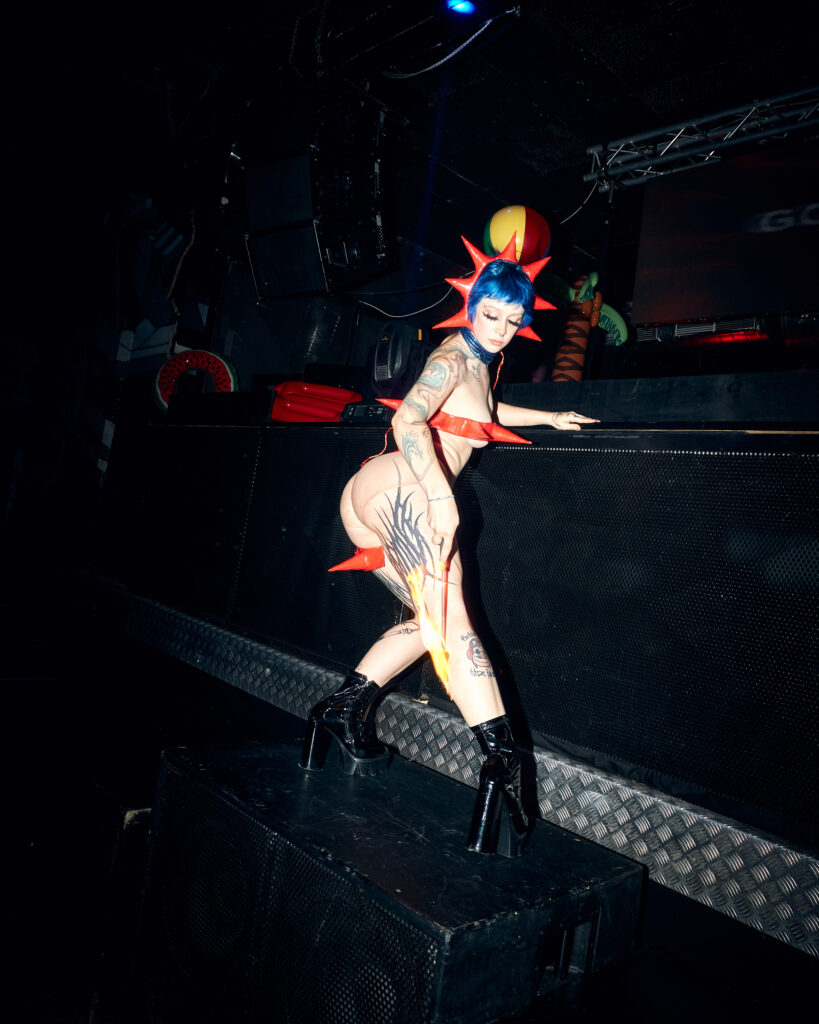
Al di là delle performance, delle maschere e dell’espressione artistica, chi è Maite nella vita di tutti i giorni?
In realtà credo che non esista una vera separazione tra Maite e la mia pratica artistica. Non sento di nascondermi dietro le performance, anzi: sono probabilmente il luogo in cui riesco a essere più sincera. Attraverso di esse parlo di temi che mi appartengono profondamente e spesso racconto anche il mio stato emotivo. Mi è sempre risultato più naturale farlo con il corpo che con le parole.
Ne ho parlato spesso anche durante il mio percorso di terapia: la performance è diventata uno strumento attraverso cui riesco a elaborare emozioni e domande che altrimenti farei fatica a esprimere. Non sostituisce il dialogo, ma lo affianca, permettendomi di conoscermi più a fondo.
Trasferirmi a Milano è stato un atto di libertà, ma anche una grande responsabilità. Ho dovuto imparare a gestire contemporaneamente lo studio, il lavoro, la casa e una vita nuova. Ci sono stati momenti in cui mi sono sentita molto sola e ho avuto la sensazione di non essere compresa, anche perché spesso ero io la prima a non comprendere fino in fondo me stessa.
La terapia, insieme alla mia ricerca artistica, mi sta aiutando a costruire una maggiore consapevolezza di me stessa. Allo stesso tempo ho trovato una comunità di persone che considero una famiglia scelta: artisti, performer e amici con cui condivido idee, dubbi e sperimentazioni.
Credo che Maite, nella vita di tutti i giorni, sia una persona estremamente curiosa. Mi affascina osservare ciò che gli altri ignorano, raccogliere materiali destinati a essere buttati, immaginare nuove possibilità e lasciarmi sorprendere dagli incontri. È la stessa curiosità che porto nelle mie opere: il desiderio di continuare a trasformarmi senza smettere di farmi domande.
Se guardi a quello che verrà, ci sono progetti o collaborazioni che stai già pianificando? Qual è l’opera o la performance che hai in mente ma che non hai ancora realizzato, e dove vorresti che ti portasse la tua ricerca nei prossimi anni?
In questo momento sono molto proiettata verso ciò che verrà. Sto concludendo il mio percorso universitario e sento il bisogno di tirare le fila di tutto quello che ho vissuto e sperimentato in questi anni, cercando di dare una forma sempre più consapevole alla mia ricerca.
Guardando indietro ai miei lavori precedenti, mi rendo conto che molti dei temi che oggi considero centrali erano già presenti, ma in una forma più inconscia. Il corpo, il limite, la trasformazione, la relazione con il pubblico e il rapporto tra abito e identità erano elementi che emergevano spontaneamente nelle mie opere, prima ancora che riuscissi a riconoscerli come parte di una ricerca precisa. Negli ultimi anni ho iniziato a studiarli e approfondirli maggiormente, costruendo un linguaggio più consapevole e articolato.
Questo percorso troverà una sua sintesi nella mia tesi di laurea, che culminerà in una performance inedita. Sarà un progetto in cui confluiranno tutti gli elementi che hanno attraversato il mio percorso: fashion design, performance art, body modification, suono e partecipazione del pubblico. Mi interessa creare un’esperienza in cui il corpo non sia soltanto osservato, ma diventi uno spazio di trasformazione, relazione e condivisione.
Un aspetto per me molto importante sarà anche la dimensione familiare del progetto. Mia madre, che nella vita lavora come piercer e tatuatrice, sarà coinvolta nella performance. La sua presenza non sarà soltanto quella di una professionista che interviene sul corpo, ma rappresenta anche un legame con le mie origini: il mondo dell’arte di strada, della modificazione corporea e di una cultura underground con cui sono cresciuta.
Per realizzare questa performance sto lavorando insieme a un gruppo di persone che considero molto più di un semplice team. Ognuno porta competenze diverse, ma soprattutto una fiducia reciproca che rende possibile sperimentare senza paura. Per me la pratica artistica è anche questo: un gesto collettivo che prende forma attraverso le relazioni che costruiamo.
Guardando al futuro, vorrei continuare a sviluppare questa ricerca portandola sia negli spazi indipendenti e underground, che sento profondamente miei, sia all’interno delle istituzioni dedicate all’arte contemporanea. Mi interessa collaborare con artisti provenienti da discipline diverse e continuare a interrogarmi sul corpo come luogo di trasformazione, memoria e incontro.
Grazie Maite.
Alla prossima!
Gianmaria Simone
I find artists who use their own bodies as the canvas for their art immediately compelling, as well as genuinely honest. Because, after all, what is art? It is the refined expression of what we carry within ourselves: our history, the experiences that shape us, the things we care about, the messages we wish to communicate, and our identity.
My name is Gianmaria Simone, and through Minimal Magazine I collect, analyze, and share what I find meaningful. First and foremost for myself: a way to engage with those who choose different languages and, through different tools, narrate what I try to explore with pen and paper.
Maite is an artist I have wanted to interview for a long time. Struck by the impeccable aesthetic research that emerges from her social media profile (link at the bottom of the page), I wanted to go beyond appearances and understand what lies behind the photographs. From the length of today’s article, it is easy to understand that the answer is: a great deal.
The body, as we were saying. The body can become a vehicle for emotions, profound messages, universal statements, and an endless generator of different feelings. When performances are built around it, when it is accompanied by a precise aesthetic, by garments, objects, and carefully chosen symbols, it can be removed from the purely individual dimension and open up a broader reflection, one capable of moving beyond the single performer.
It is an expressive model that I deeply admire — perhaps even envy. But what does it take, beyond a good amount of courage, to pursue this path within the art world? I have brought Maite here precisely to try to answer this question.
In her, I found a structured artist, aware of her own journey and of the direction in which she is guiding her creative research. A mature artist whom I am delighted to welcome today on the pages of the Magazine.
Hi Maite, and thank you for being here to share your story with Minimal Magazine. Looking back at your journey, from the Art High School in Cuneo to where you are today in Milan, how would you describe your evolution and what were you searching for in this change of environment?
Hi, thank you for the opportunity!
When I look back at my journey, I realize that it has not been a succession of changes, but rather a gradual process of moving closer to who I truly am. Each phase has taught me a different language: first the image, then the body, and finally performance. Today, these elements naturally coexist within my artistic practice.
At the Art High School, I did not yet have a clear idea of what my future would look like. I chose Graphic Design because it was the language I felt closest to at that time, but around the same period something happened that would change the course of my path.
Some friends of mine, photography students, began involving me as the subject of their photo shoots. I was only sixteen years old and, without realizing it, I had already begun questioning the relationship between my body and the image.
Over time, simply being in front of the camera was no longer enough. I started creating the concepts for the photographs myself, collaborating with photographers to build images that reflected my own imagination. That was when I understood that I did not want to be only the subject of an artwork, but also the person who conceives and directs it.
From that moment on, I started travelling more and more: first Turin, then Rome, and finally Milan. Each city allowed me to meet artists, performers, and creatives who expanded my perspective and nourished my research.
I come from the province of Cuneo and, while growing up, I often felt that environment was too narrow for the person I was becoming. I felt the need to engage with more open realities, where experimentation was considered a possibility rather than something to be viewed with suspicion.
After graduating, I looked for an academy I could afford through a scholarship and moved to Milan. It was a liberating choice, but also a very demanding one. I had to learn how to build my daily life independently, facing responsibilities, relationships, and an extremely competitive environment. It was not always easy, but every experience helped me define my identity more clearly.
Today I feel that I have found a community of people who believe in my research and support even the most daring ideas. Looking back, I realize that every step has brought me closer to the person and artist I am today.
In your performances, you often use elements from the circus world, from makeup to fire-eating practices. How did these languages enter your art, and what do they allow you to express?
The language of circus has been part of my story even before I was born. My parents were street performers and for years they travelled, especially in Spain, creating fire shows. I grew up observing that world closely and, from an early age, my parents enrolled me in a circus school. That is where I learned how to ride a unicycle, an experience that taught me, from a very young age, the importance of balance, coordination, and trust in the body.
Fire came a little later. When I was a child, my mother would occasionally let me hold the poi, and during my high school years I sometimes used them to animate small parties with friends. At that stage, however, it was still a game: a family heritage that I had not yet consciously decided to make my own.
The real turning point came in 2022, with my move to Milan. Thanks to some friends, who are still my training partners today, I began practising fire performance consistently, studying movement and technique in a much more conscious way. From only knowing how to use poi, I moved on to fans, staffs, and fire cups, building increasingly complex performances. In recent years, I have also started working again with stilts, bringing back into my practice another element of circus language that I had temporarily set aside.
These disciplines opened the doors to the world of entertainment for me, allowing me to perform in venues, events, and festivals. But above all, they taught me something about the body. Whether it is a unicycle, stilts, or fire, every practice requires absolute presence: every movement must be precise, every hesitation can have consequences. These experiences force you to listen to yourself, trust your body, and accept risk without being overwhelmed by it.
I believe that this is precisely where circus language meets my artistic research. For me, circus is not merely a spectacular tool or an aesthetic reference. It is a school of the body. It taught me how to live with limits, fear, balance, and transformation. These are themes that now run through all of my performances, even when circus is not explicitly present on stage.
You constantly move between body-based performance and fashion design. What kind of dialogue exists, for you, between the naked body and the garments you create?
The relationship between the body and clothing is at the centre of my research. I studied Fashion Design, but my interest in clothing began much earlier than university. Growing up in a small town, the way I dressed was one of the first tools through which I affirmed my identity. I felt the need to express myself freely, even when that meant appearing different or being judged.
I understood very early on that clothing is never just an object: it is a language.
Clothing is an extension of the body, almost a second skin. I am interested in designing garments that follow its movements, its vulnerabilities, and its transformations. For this reason, in my work, fashion and performance are not two separate disciplines, but parts of the same creative process.
I chose performance because it is the language that, more than any other, allows me to truly place the body at the centre. I am not interested in representing an experience: I am interested in living it together with the audience. It is within the uniqueness and unrepeatability of the action that I find the meaning of my work.
The garment therefore also becomes a political tool. In a society that increasingly tends towards homogenization, I believe that the way we choose to inhabit our bodies and present ourselves can be an affirmation of identity. For me, dressing does not mean hiding, but declaring one’s presence.
In works such as “Feeling Fully” or “How It Hurts”, you introduce physical pain into the performance. What is your relationship with this dimension during the action?
Physical pain entered my research in an increasingly conscious way after I moved to Milan. I am particularly interested in its relationship with suffering: I question whether voluntarily experiencing physical pain can become a way of understanding, processing, or giving form to an inner pain that we often cannot even name. A pain that, in different forms, belongs to everyone and connects us as human beings.
I am interested in understanding what happens when the body goes through an intense experience and how this can create a space for reflection, both for myself and for those who observe. From an anthropological perspective, pain has accompanied rituals of transition, transformation, and belonging for centuries; art, in the same way, allows us to give form to emotions that would otherwise remain invisible. When these two dimensions meet, the body becomes a space of relation, capable of generating empathy and catharsis.
For a long time, I used the word “healing” to describe this process. Then, through a conversation with an artist who is very dear to me, I began questioning that word. I realized that we live in a society that constantly demands that we heal, improve, optimize, and overcome, as if every form of fragility had to be eliminated as quickly as possible.
Today I feel that art should not be about healing people, nor should pain always require a solution. Rather, I believe it can help us understand ourselves better, recognize what we feel, and choose how to coexist with our vulnerabilities.
For me, performance is exactly this: a space in which the body stops chasing the idea of perfection and efficiency imposed by our society. Through pain, the body slows down, exposes itself, reveals its vulnerability and, precisely because of this, becomes almost dysfunctional within a system that expects us to always be productive, high-performing, and invulnerable. It is within that vulnerability that I find the possibility of taking a position: not the search for a better body, but for a freer, more conscious, and more authentic one.
Public spaces, museums, nightclubs: you bring your performances into radically different environments. How do the space and the type of audience influence what you do?
I like to think that my performances do not belong to a single type of space. I do not want them to exist only inside museums or institutions, also because I believe that art spaces are not always accessible to everyone. I am interested in the possibility that my work can live in different contexts, because every place changes the way the audience enters into a relationship with the artwork.
My personal background is deeply connected to social spaces, community centres, squats, clubs, and alternative environments. These are places I have been part of for years and where I have always found great freedom for experimentation. It is there that I learned that a performance can also be extreme, disturbing, or visually powerful without needing to be normalized in order to become acceptable. These spaces continue to represent a fundamental part of my artistic and political identity.
I am fascinated by observing how the same performance can completely change depending on the space in which it is presented. I often develop a work in the studio and then bring it to a stage, a club, or an event. Each time, the context produces different reactions and forces me to rethink the work: sometimes for technical or logistical reasons, other times because it is the audience itself that transforms the meaning of the action. It is a process of continuous experimentation, from which I always learn something.
Over the past year, however, I have felt the desire to move closer to artistic institutions. Visiting the Venice Biennale and engaging with artists and students coming from backgrounds connected to contemporary art and performance art made me understand how important it is to deepen my research in that direction as well, without abandoning the roots I come from.
What I imagine for the future is not a transition from one world to another, but a bridge between these two contexts. I would like to continue working in social and politically conscious spaces, which feel deeply connected to who I am, while bringing the same energy, the same freedom of experimentation, and the same expressive urgency into institutional contexts. For me, coherence does not depend on the place where I exhibit, but on the way I choose to inhabit that space and on the audience’s willingness to truly engage.
In “uMANItà”, the audience directly intervenes on your body with paint. What happens inside you when you completely entrust the outcome of your work to others?
uMANItà was the first performance I created. I was eighteen years old, and during that period I was exploring the work of Marina Abramović and Regina José Galindo, two artists who helped me understand how the body could become a political language as well as an artistic one.
The performance was created for November 25th, the International Day for the Elimination of Violence Against Women. I felt the need to create an image that could reach the audience without mediation: like a slap or, on the contrary, like a caress.
I wore a flesh-coloured bodysuit and remained still for around half an hour in the centre of Piazza Galimberti, in Cuneo, while people were invited to leave a mark of pink paint on my body. It was extremely cold, and every wet hand touching me made that sensation even more intense. But during those thirty minutes, the cold completely faded into the background.
In my mind, the names of the women killed in Italy that year kept echoing. Those were the women I was thinking of while watching the audience approach. Some people chose to touch my face with extreme delicacy, while others placed their hand on my neck. They were simple gestures, but deeply different from one another.
In those moments, I tried to listen not only to what I was feeling, but also to what I perceived in others. Every touch seemed to carry a story, a memory, a fear, or a need for closeness.
Entrusting my body to the audience meant accepting that I could not completely control the outcome of the performance. It was an act of vulnerability, but also of trust. I believe that the meaning of uMANItà was precisely within that exchange: transforming an apparently simple gesture into a moment of shared responsibility, where the body became a space of listening and empathy.
In the field of fashion design, you make extensive use of upcycling and textile customization. What fascinates you about working with materials that already carry a story?
When I design a garment, it is very rare for me to buy new materials. This choice comes first and foremost from an ethical reflection: I struggle to justify continuously purchasing new fabrics at a time in history when we produce and consume enormous quantities of clothing destined to last very little. Fast fashion has accustomed us to considering objects as easily replaceable, while I try to do exactly the opposite.
Over the years, I have kept almost everything that was about to be thrown away at home: old clothes, fabric scraps, accessories, and recovered materials. Today my studio is full of these things and represents a kind of personal archive that I draw from whenever I begin a new project.
Furthermore, as you said, I am fascinated by the fact that these materials have already lived. They carry marks, imperfections, and a story that I cannot fully know, but that continues to exist within them. When I transform them, I do not try to erase their past, but rather make it dialogue with something new. I like to think that objects, too, can have a second chance.
For me, upcycling is not only a design technique, but a way of looking at the world. I often find myself walking down the street and stopping in front of something that, to anyone else, would simply be waste. A fragment of plastic, a motorcycle part, a metal mesh, or an unusual material is enough for my mind to immediately imagine how it could become a garment or a performative element.
Perhaps this is also why my home is full of unlikely objects. I find it difficult to part with them because each one could become the starting point for a future project. It is precisely this constant possibility of transformation that continues to excite me: seeing something destined to be forgotten reborn as a unique, unrepeatable piece with a new identity.
Beyond live performances, modeling, and fashion design, you also use the OnlyFans platform. A different, fetish-based approach that, at its core, shares the same performative use of the body that fuels your performances. Beyond the economic aspect, has this so-called erotic research contributed in any way to your art? Has it given you greater self-awareness or inspired other projects?
It is not my habit to talk about my work as a sex worker alongside my artistic research. Not because there is no dialogue between the two — on the contrary — but because I know that, especially in Italy, this topic is still heavily stigmatized. A few months ago, during a talk organized by the editorial team of Scomodo in Milan, I spoke precisely about this difficulty: the fear that one aspect of my work might overshadow everything else, that my path might be interpreted through a single lens rather than in its full complexity.
There is still the idea that a person cannot simultaneously be an artist, a performer, a model, and a sex worker. As if one definition automatically cancels out all the others. This is the mechanism I find most limiting, because it prevents people from truly looking at the research behind my work and at the person as a whole.
At the same time, however, it would be dishonest to deny how much this experience has influenced my relationship with my body. Working with nudity and with the exposure of myself has forced me to confront, every day, both the gaze of others and my own. It has given me a level of bodily awareness that I probably would not have developed in the same way, teaching me to inhabit my body with greater freedom and intention.
This experience also led me to approach the political dimension of the fight for sex workers’ rights. The conversations with other people who share this reality helped me understand how social stigma can become a form of exclusion and control, and how important it is to claim the possibility of self-determination over one’s own body and work.
This reflection naturally entered my artistic research as well. The performance I presented after that talk addressed precisely these themes through the image of chains and bonds marking the body: symbols of prejudice, labels, and forms of control — even invisible ones — that often limit the freedom to be recognized in one’s own complexity.
Beyond performances, masks, and artistic expression, who is Maite in everyday life?
In reality, I do not think there is a real separation between Maite and my artistic practice. I do not feel that I hide behind performances; on the contrary, they are probably the place where I manage to be the most sincere. Through them, I speak about themes that deeply belong to me and often reveal my emotional state as well. It has always felt more natural for me to do this through my body rather than through words.
I have often spoken about this during my therapy journey as well: performance has become a tool through which I can process emotions and questions that I would otherwise struggle to express. It does not replace dialogue, but accompanies it, allowing me to understand myself more deeply.
Moving to Milan was an act of freedom, but also a great responsibility. I had to learn how to manage studying, working, maintaining a home, and building a new life all at the same time. There were moments when I felt very alone and had the sensation of not being understood, also because often I was the first person who did not fully understand myself.
Therapy, together with my artistic research, is helping me build a greater awareness of myself. At the same time, I have found a community of people who I consider a chosen family: artists, performers, and friends with whom I share ideas, doubts, and experimentation.
I believe that Maite, in everyday life, is an extremely curious person. I am fascinated by observing what others overlook, collecting materials destined to be discarded, imagining new possibilities, and allowing myself to be surprised by encounters. It is the same curiosity that I bring into my work: the desire to continue transforming myself without ever stopping asking questions.
Looking ahead, are there projects or collaborations that you are already planning? What is the work or performance you have in mind but have not yet created, and where would you like your research to take you in the coming years?
At this moment, I am very focused on what is to come. I am completing my university journey and I feel the need to bring together everything I have experienced and explored over these years, trying to give my research an increasingly conscious form.
Looking back at my previous works, I realize that many of the themes I now consider central were already present, but in a more unconscious form. The body, the limit, transformation, the relationship with the audience, and the connection between clothing and identity were elements that emerged spontaneously in my works, even before I was able to recognize them as part of a precise research path. In recent years, I have started studying and developing them more deeply, building a more conscious and articulated language.
This journey will find its synthesis in my graduation thesis, which will culminate in an original performance. It will be a project where all the elements that have crossed my path will come together: fashion design, performance art, body modification, sound, and audience participation. I am interested in creating an experience in which the body is not only observed, but becomes a space of transformation, relation, and sharing.
Another very important aspect for me will be the family dimension of the project. My mother, who works as a piercer and tattoo artist, will be involved in the performance. Her presence will not simply be that of a professional intervening on the body, but also represents a connection to my origins: the world of street art, body modification, and an underground culture that I grew up with.
To create this performance, I am working together with a group of people whom I consider much more than just a team. Each person brings different skills, but above all a mutual trust that makes experimentation without fear possible. For me, artistic practice is also this: a collective gesture that takes shape through the relationships we build.
Looking toward the future, I would like to continue developing this research by bringing it both into independent and underground spaces, which feel deeply connected to me, and into institutions dedicated to contemporary art. I am interested in collaborating with artists from different disciplines and continuing to question the body as a place of transformation, memory, and encounter.
Thank you, Maite.
See you next time!
Gianmaria Simone
I contatti dell’ospite
I nostri contatti social
Ahaa, its good conversation on the topic of this post here at this weblog,
I have read all that, so now me also commenting here.